+55 21 3197-4219
Silent Expansion: The Rise of Criminal Organizations and Their Impact on Corporate Security in Brazil
The expansion of Brazil’s two largest criminal factions — Primeiro Comando da Capital (PCC) and Comando Vermelho (CV) — beyond drug trafficking borders represents an increasingly complex and multifaceted challenge for public security and, critically, for the Brazilian business sector.
This article aims to analyze the intricate chain of events and relationships between these two criminal organizations, with a deep dive into their infiltration of legitimate markets such as fuel distribution and internet service providers.
We will outline a timeline of recent developments, present alarming statistical data, and discuss the direct implications for corporate security, loss prevention, and macroeconomic market analysis — providing essential insights for strategic decision-making in the business environment.
From Drug Gangs to Organized Crime: The Evolution of Brazil’s Criminal Factions
Originating in the 1990s and 1970s, respectively, the Primeiro Comando da Capital (PCC) and Comando Vermelho (CV) initially emerged as factions focused on controlling drug trafficking and imposing their own codes of conduct, both in urban peripheries and within the prison system. Over time, these organizations built a solid base of territorial and symbolic power, asserting their authority in communities marked by the absence of the State and severe socioeconomic vulnerability.
In recent years, however, these factions have undergone a significant structural transformation, shifting from a traditional criminal model to an organizational logic with mafia-like characteristics. This evolution includes the diversification of illegal income streams—such as control over clandestine internet distribution, the fuel market, informal trade, loan sharking, and even the exploitation of security and transportation services. This process has been accompanied by increasingly sophisticated money laundering strategies, the use of shell companies, the acquisition of assets through frontmen, and infiltration into segments of the formal economy.
The operations of these groups have evolved from being purely violent to becoming financially driven and strategically planned. In several regions, the PCC and CV maintain tacit non-aggression pacts to avoid unnecessary conflicts, sharing areas of influence or jointly exploiting parallel markets. This does not eliminate confrontations—which still occur over disputes for international routes or key regions—but it reflects a new level of organization and criminal rationality.
Furthermore, these factions are increasingly expanding beyond national borders, controlling international logistics routes, partnering with foreign cartels, and establishing a presence in neighboring countries. The PCC model, for instance, is marked by a decentralized, business-oriented structure, while the CV maintains a more territorial and militarized approach—differences that shape their distinct expansion and conflict dynamics.
Timeline: An Alarming Escalation
PRIMEIRO COMANDO DA CAPITAL (PCC)
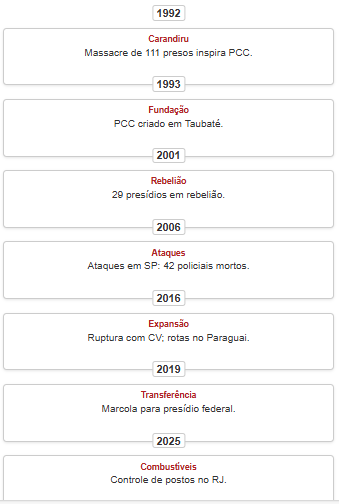
The Primeiro Comando da Capital (PCC) is Brazil’s largest criminal faction, founded in 1993 by eight inmates at the Taubaté Penitentiary (São Paulo) in the aftermath of the Carandiru Massacre. It emerged as a response to prison conditions, adopting the motto “Peace, Justice, and Freedom.” Over time, the group expanded its operations beyond prison walls, gaining control over drug trafficking, robberies, kidnappings, and more recently, the fuel distribution sector.
Today, the PCC has an estimated 40,000 members, operates in 22 Brazilian states, and maintains international connections, including ties to the Italian mafia group ‘Ndrangheta. Its strategy involves diversifying criminal activities and competing for territory, even in areas traditionally controlled by rivals such as the Comando Vermelho.
COMANDO VERMELHO (CV)
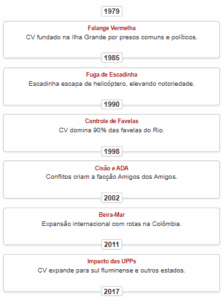
The Comando Vermelho (CV) is one of Brazil’s largest and oldest criminal factions, founded in 1979 at the Cândido Mendes Penal Institute on Ilha Grande during the military dictatorship. It originated from the coexistence of common and political prisoners, initially under the name Falange Vermelha, adopting the motto “Peace, Justice, and Freedom.” Its founders included William da Silva Lima (“Professor”), José Carlos dos Reis Encina (“Escadinha”), and Rogério Lemgruber.
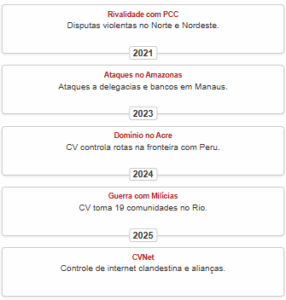
In the 1980s, the CV expanded into drug trafficking, armed robberies, and the control of favelas, reaching a point in the 1990s where it influenced up to 90% of Rio’s communities. Despite facing rivals such as the TCP, ADA, and militia groups, the CV maintains a strong national presence, operating in 21 Brazilian states and abroad, notably along routes through Bolivia, Peru, Colombia, Europe, and Africa.
In recent years, it has expanded further into Brazil’s North and Northeast, competing with the PCC for territory and diversifying its activities, including control of clandestine internet services (“CVNet”) and forming alliances with militia groups in parts of Rio’s West Zone.
STRATEGIC INFILTRATION INTO THE FUEL AND INTERNET SECTORS
Recent investigations, such as the “Espectro” Operation launched by Rio de Janeiro’s Civil Police in April 2025, and reports from entities like the Fuel Retail Trade Union (Sindcomb) and the Brazilian Forum on Public Security (FBSP), raise serious red flags about the operations of these criminal organizations in key sectors of the economy.
PCC AND ITS CONTROL OF THE FUEL MARKET
The Primeiro Comando da Capital (PCC) has implemented an aggressive expansion strategy in the fuel sector. Illicit activities range from the direct theft of crude oil from pipelines to product adulteration and the acquisition and control of gas stations. Rio de Janeiro, traditionally dominated by the CV, has become a new and concerning target for PCC’s operations in this sector.
The strategy aims not only for direct profits but also for laundering vast sums of money derived from drug trafficking. Companies in the sector face brutal unfair competition, while corporate fleets run the constant risk of fueling with adulterated gasoline, resulting in mechanical and operational losses.
The macroeconomic impact is devastating, with annual tax losses estimated at R$ 23 billion solely from fraud and tax evasion in the fuel market, according to FBSP data.
COMANDO VERMELHO AND THE MONOPOLY OF INTERNET SERVICES IN LOW-INCOME AREAS
Meanwhile, Comando Vermelho has found a lucrative source of income in the internet service provider market, especially in communities where the State has little presence. The faction exploits regulatory loopholes that waive the need for an operating license from the National Telecommunications Agency (Anatel) for companies with fewer than 5,000 active customers.
By creating companies under the names of frontmen (“laranjas”), CV establishes a de facto monopoly, often coercing residents and businesses into using their services, which are frequently of questionable quality. For companies requiring connectivity in these areas, or for those seeking to expand their own telecommunications services, the environment is high-risk, involving extortion and the inability to operate legally.
The Anatel Loophole and the Spread of Unlicensed ISPs
In recent years, Anatel’s regulatory gap has allowed small internet providers to operate with a simple registration, without a formal license, as long as they operate at the municipal level. The rule, created to expand internet access, has been exploited by criminal groups like Comando Vermelho and militias, who have built illegal or semi-legal networks—such as the so-called “CVNet” or “gatonet”—to dominate territories and profit from the service.
Limited oversight and the use of fraudulent tax IDs (CPFs and CNPJs) make controlling these operations difficult. Even with Anatel’s recent actions, the lack of traceability and adequate technical requirements still favors criminal activity. This reinforces the urgent need for stricter and more effective regulation of the sector.
TACTICAL AGREEMENTS AND MONEY LAUNDERING
Despite a long-standing rivalry and bloody territorial disputes, intelligence reports and statements from officials such as the National Secretary of Public Security, Mário Sarrubbo, indicate the existence of “tacit agreements” or “strategic pacts” between PCC and CV in these new markets.
In Rio de Janeiro, for example, while the PCC expands into fuels, CV maintains its dominance over the internet sector, avoiding direct conflicts that could jeopardize these new and profitable revenue streams. Money laundering drives this infiltration, with transactions often carried out in cash to avoid detection by authorities.
THE STATISTICAL ALARM: NUMBERS THAT REVEAL THE SCALE OF THE PROBLEM
The “Follow the Products” study by the Brazilian Forum on Public Security (FBSP), released in February 2025, reveals the economic power of these criminal organizations as they infiltrate legal markets. Considering just four products (gold, beverages, fuels, and tobacco), the estimated annual revenue of organized crime since 2022 has reached R$ 146.8 billion.
Fuels and Lubricants: Lead the ranking, with an estimated illicit turnover of R$ 61.5 billion (41.8% of the total). Beverages: Follow with R$ 56.9 billion (38.8%). Illegal Gold: Moves R$ 18.2 billion (12.4%). Contraband and Counterfeit Tobacco Products: Total R$ 10.3 billion (7%).
Specifically regarding the illegal fuel market, the study points to an annual movement of approximately 13 billion liters, representing 8.7% of the total national market. Tax losses from fraud and evasion in this sector reach R$ 23 billion annually.
In relation to the exploitation of internet services by Comando Vermelho in Rio de Janeiro, the Delegacy for the Defense of Delegated Services (DDSD) recorded 210 cases in 2024, and in just the first quarter of 2025, had already logged 90 incidents, highlighting the intensification of this criminal practice.
Source: Movisafe Latin America