+55 21 3197-4219
Brazil‘s Violence Map 2026: The Country’s Most Dangerous Cities
An updated portrait of lethal violence in Brazil — with the latest available data and analysis of ongoing trends for 2025 and 2026.
📋 Note on data: The 2025 Brazilian Public Security Yearbook (19th edition), published by the Brazilian Forum on Public Security in July 2025, is the most recent official source available. It consolidates 2024 data and serves as the valid reference for 2026 rankings. The next yearbook (2026 edition, with 2025 data) is expected in the second half of 2026.
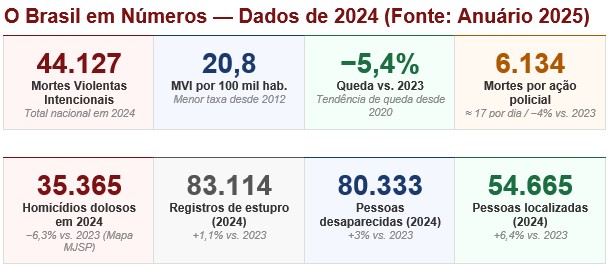
In 2024, Brazil recorded its lowest rate of Intentional Violent Deaths (IVD) since 2012: 20.8 victims per 100,000 inhabitants, a 5.4% drop compared to the previous year. The downward trend has been continuous since 2020, when the country reached a recent historical peak of 42,034 intentional homicides.
Despite the overall decline, the 19th edition of the Brazilian Public Security Yearbook highlights a concerning pattern: while violent deaths fall on average, violence against women and children, disappearances, and digital crimes are on the rise. Brazil’s public security equation is far from solved.
Trends in 2025: Warning Signs in the Northeast
Partial data from Sinesp (National Public Security Information System) for 2025, consolidated by Poder360 based on records through December 2025, show that the Northeast continues to concentrate the majority of the country’s most violent cities — 53 of the 100 municipalities with the highest homicide rates are in the Northeast. Among state capitals, Fortaleza ranks 6th among the most violent.
Isolated signs of improvement were observed in the first half of 2025 in cities such as Caucaia (−20.2% in violent deaths) and Maracanaú (−16.3%). However, Maranguape recorded a new increase of 11.5% at the turn of the year, reinforcing its position at the top of the ranking.
| ⚠️ Note: 2025 data is still partial. The 2026 Yearbook, with finalized 2025 figures, will be the official source. The trends below are based on preliminary data from Sinesp and state secretariats. |
Violence by Region: An Unequal Map
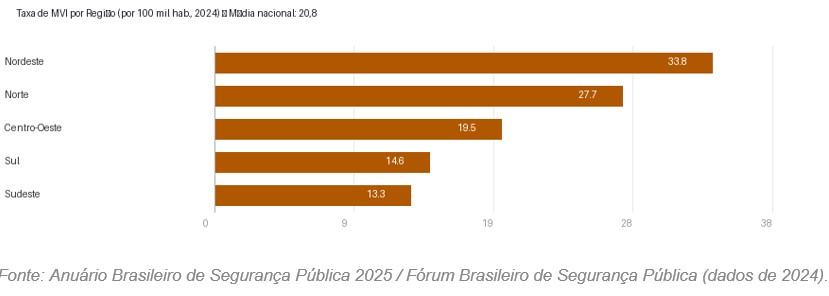
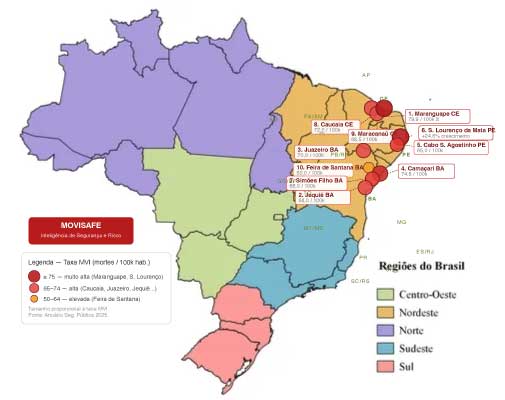
The North and Northeast concentrate the highest IVD rates — more than double the national average. The South and Southeast fall well below 20.8.
The 10 Most Violent States (2024)
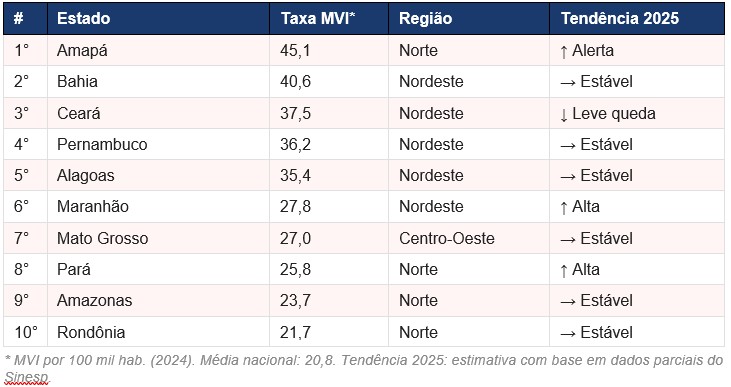
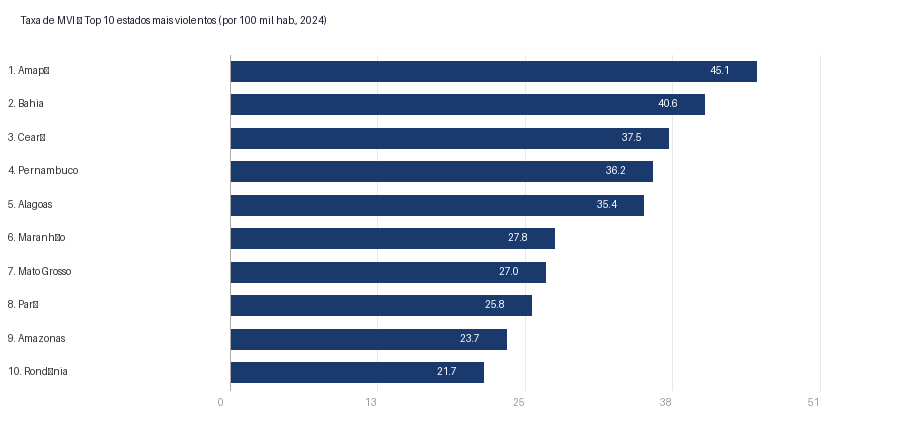
Amapá leads by a wide margin (45.1 per 100,000), followed by Bahia (40.6) and Ceará (37.5). These three states account for 7 of the 10 most violent cities in the municipal ranking.
The 10 Most Violent Cities in Brazil (Official 2025 Ranking)
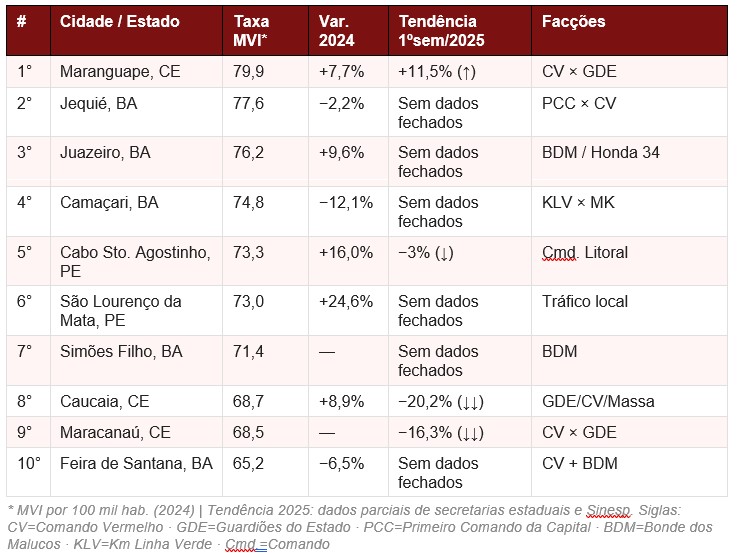
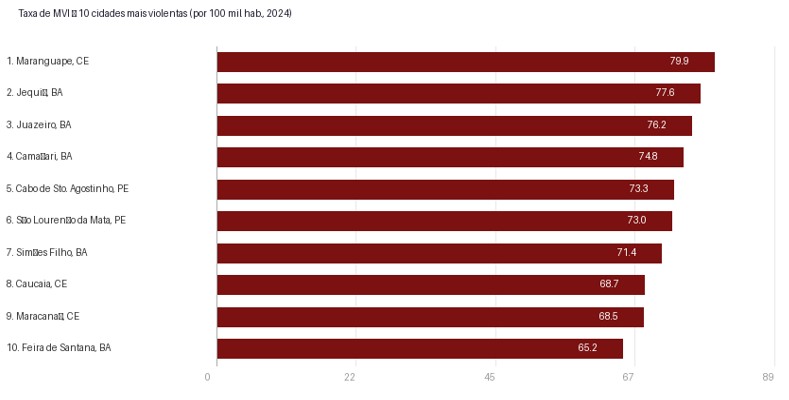
Based on the 2025 Yearbook — the most recent research and the official reference valid for 2026. Considers only municipalities with more than 100,000 inhabitants. All 10 are in the Northeast: 5 in Bahia, 3 in Ceará, 2 in Pernambuco.
Detailed Analysis: City by City
1. Maranguape (CE) — Absolute leader and accelerating
With 108,000 inhabitants located 30 km from Fortaleza, Maranguape recorded one of the largest jumps in recent history: +87% in the IVD rate between 2022 and 2023, reaching 74.2. In 2024 the rate climbed further to 79.9 — nearly four times the national average — and in early 2025 recorded a new increase of 11.5%. The city jumped from 8th to 1st place in the national ranking.
The driver of violence: the territorial war between Comando Vermelho (CV) and Guardiões do Estado (GDE). In Maranguape, only 2% of IVDs involved police action — virtually all violence is between rival factions. The “crime migration” phenomenon from Fortaleza to neighboring municipalities is identified by experts as a central factor.
2. Jequié (BA) — A third of homicides committed by police
With 170,000 inhabitants in southwestern Bahia, Jequié leads the state ranking in violent lethality. In 2024, there were 131 homicides (−2.2% vs. 2023). The most alarming figure: 44 deaths resulted from police actions — roughly 1 in every 3 cases.
The city is the stage for a dispute between PCC and CV. The high police lethality rate far exceeds that of comparable cities in Ceará and Pernambuco, placing Jequié at the center of the national debate on the need for reform in Bahia’s security forces. The state of Bahia as a whole recorded 26% of violent deaths as the result of police intervention.
3. Juazeiro (BA) — The internalization of violence
Located 500 km from Salvador with 250,000 inhabitants, Juazeiro exemplifies the expansion of organized crime into the interior. In 2024 there were 194 deaths (+9.6%). Active in the municipality are the Bonde dos Malucos (BDM) and its splinter group Honda 34 — whose conflict is responsible for the majority of deaths. The city reflects an increasingly common phenomenon: the export of factions from capital cities to mid-sized interior towns.
4. Camaçari (BA) — Industrial hub, vulnerable outskirts
Home to Latin America’s largest petrochemical complex and the former Ford factory (until 2021), Camaçari (320,000 inhabitants) illustrates the recurring paradox of economic strength coexisting with structural violence. In 2024 there was a 12.1% reduction in deaths (from 272 to 239), but the rate of 74.8 per 100,000 remains high. Territorial disputes are between local factions KLV (Km Linha Verde) and MK.
5. Cabo de Santo Agostinho (PE) — A decade on the ranking
Located 35 km from Recife, Cabo de Santo Agostinho has appeared among Brazil’s most violent municipalities for over a decade. In 2024 there were 159 deaths (+16%). Only 3% of IVDs involved police action — all violence is between factions. The city has historically been controlled by Comando Litoral (formerly Trem Bala), which disputes regional drug trafficking routes.
6. São Lourenço da Mata (PE) — The ranking’s fastest deterioration
Recorded the highest percentage growth among the 10 cities in the 2024 ranking: +24.6%, reaching 86 victims. It is the municipality that has deteriorated most rapidly in terms of security. The state government of Pernambuco announced the creation of new Military Police battalions, but São Lourenço da Mata was left off the list — triggering a strong reaction from residents and local lawmakers.
7. Simões Filho (BA) — 1 in 4 deaths committed by a police officer
With 120,000 inhabitants in Greater Salvador, Simões Filho is dominated by the Bonde do Maluco (BDM), which emerged in 2015 from the Mata Escura Prison Complex. In 1 out of every 4 recorded homicides, the perpetrator was a police officer. Together with Jequié, the municipality is at the center of criticism of Bahia’s policing model, where police lethality is disproportionately high compared to other states.
8. Caucaia (CE) — Three factions, one city — and signs of improvement in 2025
A municipality in Greater Fortaleza disputed by GDE, CV, and the Neutros (“Massa”). In 2024 homicides grew 8.9%, but the first half of 2025 showed a significant reduction of 20.2% — one of the most encouraging signs among the cities in the ranking. The dynamic is part of the “crime migration” from Fortaleza to neighboring municipalities, but police intelligence operations appear to be having an effect.
9. Maracanaú (CE) — From catastrophe to slow recovery
An industrial hub in Greater Fortaleza (230,000 inhabitants), Maracanaú reached 145.7 deaths per 100,000 inhabitants in 2017 — double the current rate. In 2024 the rate stood at 68.5, and in the first half of 2025 there was a further reduction of 16.3%, with 77 deaths compared to 92 in the same period of 2024. The downward trajectory is consistent, but the rate still stands at more than three times the national average.
10. Feira de Santana (BA) — The strategic crossroads of crime
Bahia’s second largest city, with over 600,000 inhabitants, is a strategic point for organized crime as the gateway to the Bahian hinterland and the Chapada Diamantina. The Yearbook highlights that in June 2024, a police operation in São Paulo arrested a drug trafficking leader linked to the BDM — evidence of the ties between local crime and national networks. There was a 6.5% reduction in 2024.
What the Data Reveals in 2026
The concentration of all 10 most violent cities in the Northeast — for the third consecutive year — is no coincidence. Paradoxically, the Northeast is the region that has received the most federal investment in public security over the past decade. And yet it continues to dominate rankings that no city wants to be part of.
Four structural patterns repeat themselves:
- Migration of organized crime from capitals to neighboring cities — Fortaleza, Salvador, and Recife “export” factions to smaller municipalities where security infrastructure is weaker.
- Drug trafficking disputes — the majority of deaths are linked to faction wars over control of routes and sales points. BDM, CV, GDE, and PCC are the main regional actors.
- High police lethality, especially in Bahia — the state recorded 26% of violent deaths as the result of police intervention, compared to 2–3% in Ceará and Pernambuco. In Jequié and Simões Filho, 1 in every 3–4 homicides is committed by a state agent.
- Concentrated victim profile — young males aged 18 to 24, Black, living in the urban periphery. Violence in Brazil is not random: it has a defined address and face.
Violence Is Not Destiny — It’s a Political Choice
Experts agree: reducing violence in a sustainable way requires integrated policies — quality education, income generation, urbanization of peripheral areas, sophisticated police intelligence, and long-term strategies to combat drug trafficking.
The decline in the national average is encouraging — and positive signals from Caucaia and Maracanaú in early 2025 show that reversal is possible. But as Maranguape accelerates and cities like São Lourenço da Mata record growth of 24.6%, and as 44,000 families lose someone every year, the equation remains far from balanced.
Knowing the data is the first step. The second is acting on it.
Sources: Brazilian Public Security Yearbook 2025 — 19th Edition (Brazilian Forum on Public Security, July 2025) · Public Security Map 2025 (MJSP, June 2025) · Poder360 (Jan/2026) · CNN Brasil (Jul/2025) · Atlas of Violence 2025 (Ipea) · movisafe-americalatina.com. Updated April 2026.